|
|
A Good Read
My Life in France
by Julia Child, published by Knopf
After a life of writing some of the most successful
cookery books ever, there’s not a recipe in sight in Julia
Child’s last book, ‘My Life in France’. We were
at a party at La Borde-au-Château near Beaune in the early
eighties when Julia joined the group on her way down to her home
in Provence. Several movers and shakers from Los Angeles and New
York where there, men I might add, and it was a mark of her success
that these captains of industry lined up for her autograph!
Julia has been a phenomenon in the States with her
television programmes and cookery books since the 1960s. But her
whole passion for food, and particularly French food started in
1948 when she and her husband Paul, who was in the diplomatic service,
came to live in Paris. ‘Mastering the Art of French Cooking’
which she wrote in conjunction with Simone Beck, took years of time
consuming research and became a classic work, introducing this style
of cooking to a new audience in the States. The book shows Child
as the true professional she was; it is charming and informative,
and reading it is sure to make you want to rush into the kitchen
for a little something gastronomic.
PE
|
|
|
Wine & War
by Don and Petie Kladstrup, published by Coronet Books
How the vintners protected and rescued France’s
most treasured commodity during World War II.
The wine trade in France found itself in a difficult
position during the Second World War. The Germans were requisitioning
their precious wines, imbibing it and selling it to fund the war
effort, often leaving none for the French themselves. A bad public
relations exercise if ever there was one. Through the people in
the wine trade, the war story unfolds with amusing anecdotes as
well as harrowing stories of the Resistance, prisons, the black
market, and deceit for survival.
As the authors say in their introduction ‘it
is about people, people who indeed exude wit, gaiety and good taste
and, whose love of the grape and devotion to a way of life helped
them survive the triumph over one of the darkest and most difficult
chapters in French history.’
|
|
|
Colette
The Collected Stories of Colette published by Vintage Classics
Colette was born in the Puisaye in the north west
of Burgundy in 1873. She came to be considered one of France’s
masters of prose and was given a state funeral when she died at
the age of 81. Generations ahead of her time, she was one of the
most scandalous writers of the early 20th C, using ‘sensual
detail and sharp psychological insight’ as the one hundred
short stories translated for this book reveal. From her childhood
in Burgundy, a young and unhappy marriage in Paris to Willy, six
years on the stage, and two further marriages, Colette drew on her
experiences and observation of people in stories such as ‘Bella-Vista’
and ‘The Tender Shoot’. A book to dip into time and
again.
|
|
|
Anne Willan: From My
Château Kitchen
by Anne Willan, published by Clarkson Potter, New York
This gloriously illustrated coffee table book sums
up the essence of Burgundy.
It is the story of Anne Willan’s love affair
with this region of France, interweaving chapters of her life in
the château with journeys into the countryside, and it includes
160 of her famous recipes.
Having founded the cookery school La Varenne in
Paris in 1975, Anne and her husband then bought Château du
Fey. In her own words, this was where the adventure began –
the run down château, the cooking classes, getting to know
the local farmers and shopkeepers, the cheese-makers and truffle-hunters.
Wine writer Hugh Johnson says, ‘all this is a showcase in
which Anne sets out her favourite recipes. This is food in context,
and a context to make Francophiles everywhere rejoice’.
Available from the USA at www.powells.com |
|
|
|
Beneath the Morvan Moon
by Courtney Mroch, published by Publish America
Courtney Mroch’s debut novel features a murder,
a secret and a promise.
When Gretchen Lauterbach’s grandmother gives
her a map marked with two Xs, it leads not to buried treasure but
to a lover’s remains hidden in the Morvan Forest. Now it’s
up to Gretchen to right an old wrong. If she hopes to succeed –
and keep her life – she must distinguish ally from foe, truth
from lie and realize nothing is what it seems.’ |
|
|
|
The Most Beautiful Villages in Burgundy
by J.Bentley and H.Palmer, published by Thames and Hudson
This coffee table picture book is a great souvenir
of a visit to Burgundy, or a worthy introduction to it. Hugh Palmer’s
photography captures the moment. Nothing much has changed since
he photographed the medieval villages in 1998: they are still peaceful
and calm, beautifully preserved and the architecture is stunning.
With the help of the fresh light of spring to the golden evening
light of late summer, he brings them all to life.
|
|
|
|
Maquis
by George Millar, published by Cassell
George Millar tells what it was really like living
and working in the Resistance Movement in and around Besançon
in the Franche Comté on the borders of Burgundy. Written
in 1945, it is an heroic story of a man who had been captured by
the Germans in North Africa, he then escaped to Britain and joined
the SOE. There he was trained in sabotage operations and then parachuted
into France to co-ordinate resistance efforts behind enemy lines.
Hunted day and night by the Gestapo, it shows the fight put up by
French men and women in the region. Millar was given the DSO and
MC for his efforts during the Second World War. |
|
|
|
A Year in the Merde
by Stephen Clarke, published by Bantam Press
Working for a year in Paris, Paul West, a young
Englishman discovers what the French are really like. After six
months he decides to ‘join the great Parisian tradition of
buying a piece of this rural time capsule – a maison in the
country’. Whether you have experienced town or country living
in France, this book will make you laugh out loud. They are all
experiences which you can relate to. |
|
|
| Sixty Million
Frenchmen Can't Be Wrong
by Jean-Benoît Nadeau and Julie Barlow, published by Robson
Books
Civil Servants make up a quarter of the working
population, no less, in France.
Attend the Ecole Nationale d’Administration
and you are considered amongst all else to be the height of success,
the elite, above a captain of industry or an entrepreneur. Jean-Benoît
Nadeau and Julie Barlow explain the French reliance on the State,
the power of the unions and the many paradoxes of life in France
through observations, anecdotes, history and political analysis.
‘Globalization will not spell France’s demise,’
they say, ‘What makes it work is the harmony between the spirit
of the French and the structures they have given themselves’.
Once you understand that they are different from the Anglo-American
mind-set in the same way that the Chinese or Japanese are, you will
understand ‘what makes the French so French’.
|
|
|
| The
Perfectionist, Life and Death in Haute Cuisine
by Rudolph Chelminski, published by Gotham Books
This is the story of Bernard Loiseau, one of the
golden boys of haute cuisine in France in the 1990s. From the moment
he set foot in the Troisgros as a trainee, Bernard had one ambition:
to become a top chef and gain a Michelin three star rating. Chelminski
traces the highs and lows of Loiseau’s life as he built up
his business at the Côte d’Or in Saulieu, mounted up
huge debt, and floated himself on the stock market. It makes fascinating
reading – the restaurant hierarchy, the importance of the
star ratings, the press influence and the pressures of the trade
to always do and be better.
Loiseau, a great PR strategist, had an electric
personality, but underneath the self assurance was a vulnerable
man, who at the end of the day pushed himself too far. In fear of
loosing one of his coveted Michelin stars, he shot himself. France
went into shock.
All twenty-four of the country’s three star
chefs came from far and wide for the funeral. In this small world
of haute cuisine, there is strong camaraderie and they all understood
his plight well. It is a moving story and the energy of the man
shines through the pages.
|
|
|
| Birdsong
by Sebastian Faulks
This novel by Sebastian Faulks is something of a
modern day classic. While a book about the First World War in the
trenches and tunnels of northern France can never be considered
light reading, this is so well written and researched that it is
informative, moving, and very memorable. There are moments when
you wonder whether you can go on with the book any further, but
you are involved with the central character Stephen, and go on you
must. Without revealing the plot, suffice to say, it is a valuable
book in helping to understand Europe’s recent history.
|
|
|
| Charlotte
Gray
by Sebastian Faulks
Following on from Birdsong, Faulks wrote Charlotte
Gray, set in the Second World War in France. Charlotte is working
undercover in the Resistance, and through the story, the harrowing
events of the times, the passion of love and the tragedy of war
unfold. |
|
|
| La France
Gourmande
by Marolyn Charpentier, published by Pavilion
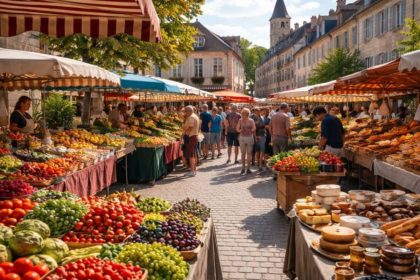
Markets are always a magnet for the visitor. For
the French, the gastronomic fairs and festivals specialising in
one product are particularly important, maintaining the traditions
of rural France. Marolyn Charpentier was clearly spoilt for choice
when researching her book, but she describes three annual events
each month of the year, ranging from the garlic festival in Gascony
in July to the Hot Bread Festival in Brittany in February. In Burgundy
she visits the Fête du Charolais in Saulieu and Les Glorieuses
in Bresse where the chicken is truly venerated. For every fête,
a recipe is included. As she concludes, ‘traçabilité’
is a word on everyone’s lips – the need to know the
source in order to uphold the quality, ‘the flavours of regional
traditions will flourish, shaped and brought to the fête with
pride, for pleasure of tasting.’ |
|
|
|